Delivered through our partner network · enterprise logos placed with permission






















Robotics AI Consulting Service helps businesses design automation strategies, integrate AI-powered robotics with existing systems, and scale intelligent automation across operations while improving efficiency, accuracy, and long-term ROI.
Modes appear repeatedly across organizations that invest in AI without a plan. Every one of them is preventable.
Many companies deploy robotics without having an AI robotics strategy to guide them, resulting in disparate projects and a lack of clarity. This means automation projects don't align with business objectives or drive value, and according to BCG, only 30% of automation initiatives succeed in scaling due to the absence of a cohesive strategy.
Legacy systems and infrastructure hinder integration of robotics with AI-powered business systems, which results in data silos, and limits real-time decision-making throughout processes. Without robotic system integration, automation will be siloed and over 70% of enterprises are struggling to connect automation with legacy systems.
When it comes to choosing robotic vendors, many companies make their decisions based on what's currently popular, rather than thinking about how well the technology will actually work with their systems. This can lead to a lot of problems, like a poor fit and higher costs.
Not all robotics projects scale from proof of concept to deployment, which hampers return on investment (ROI) and value. Without a scaling plan, automation efforts are limited to small-scale use cases, and a study estimates that nearly 70% of AI and automation trials don't scale to full production.
When companies use robots without rules, they take a big risk. This is especially true in industries where people need to know what's going on and who's in charge. If controls are not in place, companies might get fined. A lot of top organizations, about 73%, face challenges in AI automation due to data privacy compliance.
Each service is designed to remove a specific barrier between your business and the measurable AI outcomes it's capable of achieving.
Establish a vision for AI robotics to support business objectives and operational goals. Prioritise key use cases, build automation strategies and set ROI targets. This ensures robotics projects are not pilot projects and provide value in enterprise automation platforms.
 01 / AI Strategy
Leverage robotic process automation to automate rule-based, repetitive processes for increased speed, accuracy and efficiency. Increase efficiency, free up time, and boost productivity. This enhances intelligent automation capabilities while providing scalable execution across finance, operations and customer processes.
 02 / Robotic Process Automation
Connect robotic systems to enterprise systems, legacy systems and APIs to facilitate data and process integration. Break down barriers, enhance connectivity and enable real-time action. This helps with robotic system integration and realising the full potential of AI-powered robotics.
 Custom Robotics System
Build robotics features using computer vision, machine learning and sensor fusion for perception, object recognition and navigation. Improve precision and robustness in non-static environments. This facilitates decision-making and enables complex applications in AI-powered robotics operations.
 AI Perception and Autonomy
Develop and deploy reliable robotics software and middleware to facilitate communication between systems, devices and applications. Provide scalability, adaptability and efficiency. This enables seamless coordination of robotic processes and facilitates future enterprise automation.
 05 / Robotics Software
Implement robotics in a phased manner with deployment plans, testing and monitoring strategies. Maintain system stability, regulatory compliance, and ongoing optimization. This facilitates scalable robotics deployment while ensuring stability and adaptation to changing business needs.
 06 / Robotics Deployment

Define a clear robotics strategy, integrate intelligent systems, and deploy scalable automation that improves efficiency, reduces costs, and delivers measurable outcomes across enterprise operations.
We don't sell tools. We don't have a vendor quota. COGNIXIS AI Consulting agency architect the path, match the right partners, and stay in the engagement end-to-end.

Tap into a network of robotics AI consulting service experts with industry-specific expertise. This maximises capabilities for each use case, increasing project success, and delivering tangible automation results that meet business objectives.

Retain the freedom to work with any robotics platform, tools or vendors. This eliminates vendor lock-in, allows scalable automation strategies, and ensures that technology choices are made in line with changing business and operational needs.

Engage experts who know the US regulatory, operational and market environment. They understand the regulatory, operational and market needs, ensuring readiness, speed and adherence to industry standards in robotics deployment and intelligent automation.

Structure ROI communications that translate robotics investments into business results. This allows management teams to monitor and justify investments, and tie robotic investments to revenue growth, cost savings, and overall business strategy.

Accelerate project initiation with streamlined onboarding and clearly defined processes. This minimises the lag, accelerates time-to-value and enables clients to reach the benefits of robotics AI consulting service faster without extensive planning.

Provide a holistic understanding and coordination of strategy, integration, deployment and optimization. This oversight approach mitigates risk and improves the quality and scalability of robotics deployment, while enabling enterprise-wide adoption.
Robotics Consulting Service requirements differ significantly by sector. We build strategies grounded in the regulatory, competitive, and operational realities of each industry.
 01
01
Robotics AI consulting service facilitates precise automation through robotic arms, computer vision and machine learning to boost speed, accuracy and throughput. Manufacturers using AI see increases in productivity of 20-30% with improved consistency and quality.
 02
02
Our robotics AI consulting service enables autonomous mobile robots (AMRs), fleet management and smart picking for warehouse efficiency. This eliminates manual work, increases picking accuracy and speeds up order processing, with logistics automation boosting efficiency by almost 15-25% in top operations.
 03
03
AI robotics consulting service optimises clinical processes with automation in laboratories, pharmacies and patient-handling systems. Precision and error reduction are enhanced with AI-based robotics, with hospitals that implement automation reporting greater efficiency and shorter turnaround times for key processes.
 04
04
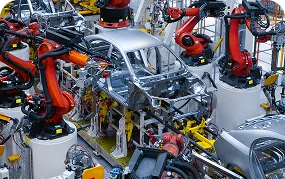
AI consulting for robotics allows for the integration of robots into complex assembly lines, inspections and navigation. Automotive industry leaders use robotics for consistency and high-volume production, with more than 70% of their manufacturing processes automated worldwide.
 05
05
Robotics AI consulting service brings automation systems for crop and harvesting management, and precision farming. Sensors and computer vision techniques help farms predict crop yield and diminish human intervention, enabling more efficient and productive farming in a changing climate.
 06
06
Robotics AI consulting service drives improvement in fulfillment through sorting, picking and packaging robotics. This speeds up order cycle times and increases delivery times, and retailers leveraging robotics report quicker order processing and scalability during peak periods.
Turn robotics investments into measurable outcomes with a robotics AI consulting service that aligns strategy, integration, and deployment with business goals, compliance needs, and long-term automation scalability across enterprise operations.

Long-form POVs, governance frameworks, and field benchmarks on what actually works in production healthcare AI. Hover to pause.

The structure, artifacts, and review cadence that satisfies TGA SaMD requirements without slowing deployment velocity.

How to connect AI systems to your EHR without creating data silos, compliance gaps, or HL7 translation nightmares.

The model design, data pipeline, and governance framework behind a validated predictive risk deployment at a regional hospital network.

A practitioner's reference for navigating overlapping privacy obligations when deploying AI across clinical data environments.

The five most common validation gaps that surface during post-go-live TGA audits — and how to close them before deployment.

Change management, privacy disclosure, and workflow design patterns from practices that achieved 70%+ documentation time reduction.

Why 60% of CDSS deployments are bypassed within 6 months — and the alert design and workflow integration principles that reverse it.

How one imaging network deployed AI-assisted triage across 8 sites while passing ARTG review and maintaining radiologist confidence.
The structure, artifacts, and review cadence that satisfies TGA SaMD requirements without slowing deployment velocity.
How to connect AI systems to your EHR without creating data silos, compliance gaps, or HL7 translation nightmares.
The model design, data pipeline, and governance framework behind a validated predictive risk deployment at a regional hospital network.
A practitioner's reference for navigating overlapping privacy obligations when deploying AI across clinical data environments.
The five most common validation gaps that surface during post-go-live TGA audits — and how to close them before deployment.
Change management, privacy disclosure, and workflow design patterns from practices that achieved 70%+ documentation time reduction.
Why 60% of CDSS deployments are bypassed within 6 months — and the alert design and workflow integration principles that reverse it.
How one imaging network deployed AI-assisted triage across 8 sites while passing ARTG review and maintaining radiologist confidence.
The questions we hear most from CIOs, procurement leads, and AI program owners before they engage us on strategy.
A robotics AI consulting service is involved in planning, designing and implementing an AI robotics project. This often involves AI robotics strategy, proof of concept (POC) development, robotics system integration and deployment. It also includes integrating robot arms, autonomous mobile robots (AMRs) and software with machine learning, computer vision, and middleware/APIs. It also includes governance, compliance and sustainability to ensure robotics programs are scalable and have a proven return on investment (ROI).
A robotics AI consulting service provides services to support physical and intelligent systems like robots, autonomous vehicles, and real-world automation through robotics and AI. It includes hardware integration, sensor fusion, LiDAR and perception. The latter, robotic process automation (RPA), consulting services work on software automation of digital tasks. RPA automates structured processes, while robotics AI consulting facilitates smart automation in the physical world and complex operations.
It varies by project scope, complexity and the customer's IT infrastructure. It usually begins with a strategy and discovery phase (a few weeks) and proceeds to proof of concept (POC) development and testing. Enhanced robotics deployment and integration can take months, particularly with legacy systems, autonomous navigation, and enterprise automation. Optimisation and support may be required after deployment for performance and scalability.
Repetitive, volume-intensive, or precision tasks are ideal. Manufacturing leverages robots and automation for assembly and inspection. In logistics, AMRs and AGVs increase warehouse and fleet efficiency. Healthcare uses robotics for operations management and retail and fulfillment for stock picking and delivery. And the fields of agriculture, automotive, and field operations make use of autonomous vehicles and robotics with AI for greater efficiency and cost savings.
Cognixis assesses business objectives, technical integration needs and industry challenges to pair them with consulting services. This involves evaluating robotics applications, integration challenges, and regulatory needs. The alignment ensures that the consulting firm has a track record of success with robotic system integration, AI robotics strategy and enterprise automation. This method mitigates risk, enables faster implementation and ensures project success.
A CTO should evaluate the readiness of the existing infrastructure, such as legacy systems, data sources and integration capabilities. The CTO should identify key use cases with a strong return-on-investment (ROI) before starting the robotics project. It's also crucial to assess governance, compliance and scalability considerations. Also, identifying internal expertise gaps in machine learning, computer vision and robotics integration helps scope the project and facilitate implementation.