Delivered through our partner network · enterprise logos placed with permission














AI workflow optimization service helps businesses automate processes, eliminate bottlenecks, and improve efficiency using AI workflow automation, intelligent process automation, and AI-powered workflow systems that deliver measurable performance outcomes.
Manual approvals set up bottlenecks in interdepartmental decision-making and workflow, which influences revenue streams. These bottlenecks inhibit agility and consequently growth as processes become more and more complex. In fact, as reported by McKinsey and Company, automation can reduce the process times by 50%, which proves the limitations of manual checks.
This is because the enterprise systems e.g., ERP, CRM and workflow management systems, are not integrated, necessitating the use of several platform log-ins and manual data reconciliation. This impedes productivity and visibility in processes, and enterprise workflow automation is difficult. According to data, employees spend almost 57% of the time on non-value work, which increases due to disjointed systems and processes.
Lack of automated workflows and compliance processes causes mistakes in compliance processes. Without AI governance and workflow orchestration, it is challenging to follow and execute audit trails and policies. According to IBM research, the mean cost of a data breach is $4.88 million and is frequently related to processes and compliance problems.
Delays in reporting delay decision-making and minimize the effect of predictive analytics processes. Without workflow analytics and telemetry, management teams are operating with outdated data. According to Gartner, poor data quality and timely insights cost an average of $12.9 million per year.
Organizations are more likely to add staff than to add processes, which adds to the cost with little to no productivity improvement. Without AI workflow optimisation, manual processes are still supreme. The inefficiency of manual methods is demonstrated by businesses that have embraced intelligent process automation, which increases their productivity by up to 40%.
Each service is designed to remove a specific barrier between your business and the measurable AI outcomes it's capable of achieving.
Identify workflow bottlenecks using process intelligence and workflow discovery. Determine inefficiencies, bottlenecks and handoffs. Establish a base to optimize workflows and support AI-driven workflow automation initiatives to promote visibility, reduce human effort and support performance gains.
 01 / Workflow Discovery
Design scalable, flexible AI-enabled workflow designs according to business and operational requirements. Orchestrate and smooth workflows using orchestration engines, APIs and AI agents. Deploy flexible, scalable, effective and long-lasting enterprise workflow automation designs.
 02 / Workflow Architecture
Build AI-powered workflows to automate decisions, approvals and task execution between departments. Use AI agents and intelligent process automation. Improve speed, consistency and throughput within the process while maintaining flexibility to business needs and change.
 03 / AI-Augmented Workflow
OCR, data extraction, and AI validation to capture, extract and validate documents. Speed up and improve the accuracy of invoices, contracts and records. Automate enterprise workflows to enhance data accuracy, remove human errors, and speed up decision-making processes using intelligent document processing in enterprise workflow automation environments.
 04 / Intelligent Document
Predictive monitoring of workflows, using real-time telemetry, to identify risks, bottlenecks and inefficiencies. Streamline prompt intervention based on AI insights. Improve business-critical process compliance, resource management and continuous workflow enhancement.
 05 / Predictive Workflow
Build APIs and automation technologies to connect enterprise systems (ERP, CRM, etc.) with workflows. Eliminate information obstacles and establish a free flow of information. Automate enterprise workflows by integrating systems, interoperating and automating enterprise-wide.
 06 / Enterprise System

AI workflow optimization service enables businesses to streamline operations, automate complex processes, and improve performance through AI workflow automation, predictive monitoring, and intelligent process automation that delivers measurable efficiency, scalability, and ROI.
We don't sell tools. We don't have a vendor quota. COGNIXIS AI Consulting agency architect the path, match the right partners, and stay in the engagement end-to-end.

Access a robust pool of expertise that matches your business needs. This approach means that the right skills are mobilised for each project, enhancing execution and delivering consistently and at scale.

Align processes to stringent regulatory and data protection standards. This approach helps achieve compliance-readiness, minimises risk and makes it possible to automate regulated business processes securely without sacrificing speed.

Prioritise business outcomes over activity-based reporting. This approach is focused on return on investment, performance enhancement and business impact, ensuring that workflow optimisation efforts align with business outcomes.

Test automation projects in a pilot phase before rolling out. This allows for low-risk experimentation, early return on investment, and a foundation to expand AI workflow optimization service across the enterprise.

Stay informed throughout the process of workflow optimization, results and benefits. Effective communication and reporting keep things on track with business goals and foster confidence throughout the process.

Access a robust pool of expertise that matches your business needs. This approach means that the right skills are mobilised for each project, enhancing execution and delivering consistently and at scale.
AI Workflow Optimization requirements differ significantly by sector. We build strategies grounded in the regulatory, competitive, and operational realities of each industry.
 01
01
AI workflow optimization service transforms processes of loan processing, fraud detection and compliance-intensive processes. It removes verification as well as accelerates the banking processes. Financial sector automation can reduce operational costs by 25% and improve accuracy in processing in high-volume environments.
 02
02
AI workflow optimization service optimises the medical documentation, claims processing, and patient enrollment. It also enhances effectiveness and precision in controlled environments. According to the World Economic Forum, AI automation in healthcare decreases the time spent by the administration, and doctors can devote more time to patient treatment and care.
 03
03
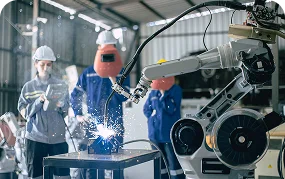
AI manufacturing workflow service improves manufacturing planning, procurement and logistics. It reduces bottlenecks and enhances supply chain forecasts. According to McKinsey, AI-enabled supply chain optimization can reduce forecasting errors by 20-50%, improving supply chain stability and capacity planning.
 04
04
Optimisation of the AI workflow service optimises the processes of fulfillment, inventory management and customer support. It increases the sensitivity to demand peaks and improves the consumer experience.
 05
05
AI workflow optimization service speeds up underwriting, claims processing and risk management. It enhances the accuracy of decisions and speeds up processes. AI in insurance workflows can shorten claims processing and enhance consistency and accuracy in detecting insurance fraud.
 06
06
AI workflow optimization service facilitates recruitment, onboarding, payroll and employee relations. It enhances HR efficiency by minimising time-consuming tasks and speeding up responses. HR automation can cut manual time spent on processing tasks by 30-50%, allowing HR to focus on strategic workforce planning.
Streamline operations with an AI workflow optimization service to eliminate bottlenecks, speed up decision-making and automate processes at enterprise scales, with clear ROI and monitoring of performance.

Long-form POVs, governance frameworks, and field benchmarks on what actually works in production healthcare AI. Hover to pause.

The structure, artifacts, and review cadence that satisfies TGA SaMD requirements without slowing deployment velocity.
How to connect AI systems to your EHR without creating data silos, compliance gaps, or HL7 translation nightmares.
The model design, data pipeline, and governance framework behind a validated predictive risk deployment at a regional hospital network.

A practitioner's reference for navigating overlapping privacy obligations when deploying AI across clinical data environments.

The five most common validation gaps that surface during post-go-live TGA audits — and how to close them before deployment.

Change management, privacy disclosure, and workflow design patterns from practices that achieved 70%+ documentation time reduction.

Why 60% of CDSS deployments are bypassed within 6 months — and the alert design and workflow integration principles that reverse it.

How one imaging network deployed AI-assisted triage across 8 sites while passing ARTG review and maintaining radiologist confidence.
The structure, artifacts, and review cadence that satisfies TGA SaMD requirements without slowing deployment velocity.
How to connect AI systems to your EHR without creating data silos, compliance gaps, or HL7 translation nightmares.
The model design, data pipeline, and governance framework behind a validated predictive risk deployment at a regional hospital network.
A practitioner's reference for navigating overlapping privacy obligations when deploying AI across clinical data environments.
The five most common validation gaps that surface during post-go-live TGA audits — and how to close them before deployment.
Change management, privacy disclosure, and workflow design patterns from practices that achieved 70%+ documentation time reduction.
Why 60% of CDSS deployments are bypassed within 6 months — and the alert design and workflow integration principles that reverse it.
How one imaging network deployed AI-assisted triage across 8 sites while passing ARTG review and maintaining radiologist confidence.
The questions we hear most from CIOs, procurement leads, and AI program owners before they engage us on strategy.
An AI workflow optimization service reviews current business processes to find bottlenecks in systems, teams and tools. It involves process mapping, workflow redesign, automation potential mapping, AI enablement plans and tracking to enhance speed, accuracy and efficiency.
Traditional automation automates tasks based on rules, whereas an AI workflow optimization service optimises entire workflows with intelligence, prediction, and learning. It improves agility, dynamically eliminates bottlenecks and facilitates process improvement rather than automation.
Workflows with a high volume, repetitive nature and prone to delay, such as approvals, customer onboarding, invoicing, and reporting, should be the first. This is where you will see the quickest effect as these are directly linked to cost, speed, and efficiency.
Depending on the complexity of the system, it takes 6 to 16 weeks for enterprise deployments. This covers discovery, process mapping, design of AI workflow integration, piloting and assessment, and then scaling across the enterprise.
The process starts with a review of workflow issues, business objectives and IT infrastructure. This helps pair businesses with targeted AI consulting partners, tailored to industry verticals, technology requirements and growth aspirations.
Pricing varies based on workflow complexity, integration requirements and automation scale. Businesses generally opt for pilot-based approaches, with scaling in line with demonstrated return on investment, allowing for planned investment and operational benefits before full roll-out.